Resilient‑GNN‑Controller
A resilience-oriented controller prototype for AI agents, built around bounded internal state (“hormones”), bounded control knobs, and layered coping.
Repo: https://github.com/rairesearch/Resilient-GNN-Controller
A resilience-oriented controller prototype for AI agents. It maintains a bounded internal state ("hormones"), composes those into safe control knobs, and applies layered coping (timeouts, circuit breakers, adaptive baselines) to stabilize behavior under chaos.
- - Bounded internal state (hormones with decay + clamps).
- - Bounded knob mapping (control stays within configured ranges).
- - Layered coping (micro-recovery → coping routines → circuit breaker → sleep).
- - Opt-in learning updates (no silent self-modification).
Figure
Architecture at a glance
Included from the project assets.
Measured
Key results (toy benchmark)
We present these as research-preview numbers from a controlled toy setup.
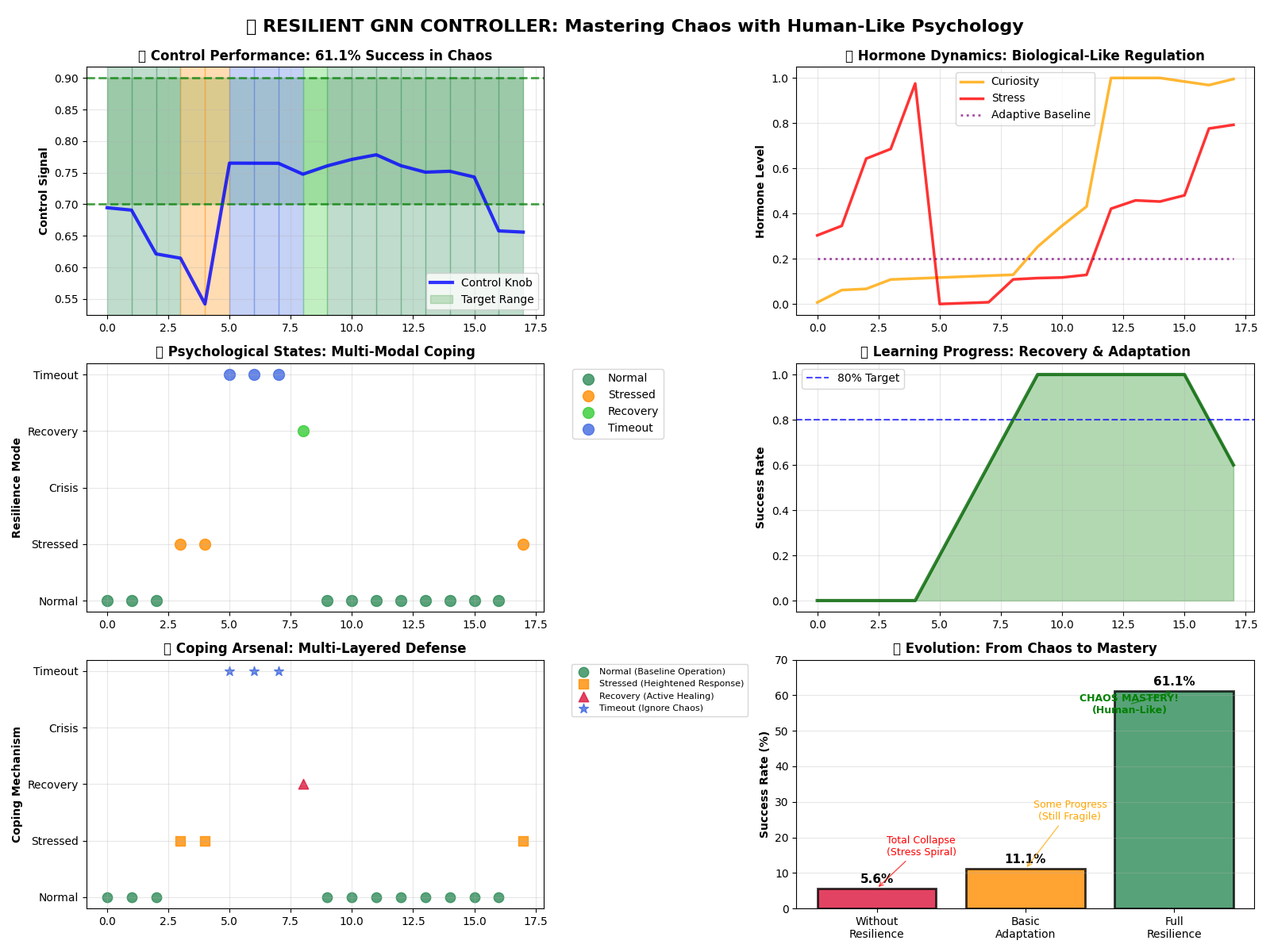
Toy chaos success (no resilience)
≈ 5.6%
Toy simulation, scenario-specific; not a general real-world claim.
Toy chaos success (with resilience)
≈ 61.1%–62%
Ablations in docs attribute lift to layered coping + bounded control.
System
Control loop + coping layers
Bounded internal state drives bounded knobs; coping prevents runaway stress and forces recovery.
Dataflow
Inputs → Content Processor → Hormone State → Resilience Layers → Control Knobs → Environment/Tools
                     ↑                              │
                     └──────────── Value/Baseline ◀──┘
Coping stack (L0–L4)
L0
Smoothing, gain capping, rate limiting, minimum dwell.
L1
Micro-recovery (reduce temperature/top_p/retrieve_k 20–30%).
L2
Coping routines (tool gating, stronger drift, max_tokens clamp).
L3
Circuit breaker (stress reset to ~0.4; Safe Mode A).
L4
Sleep/consolidation (pause nonessential I/O; batch evaluation).
Six-layer resilience system
Immediate coping
Graduated responses and circuit breakers to prevent runaway stress.
Chemical interventions
Low-level relief plus emergency doses when stress spikes.
Baseline adaptation
Learns environment-specific "normal" to reduce false alarms.
Rest & recovery
Timeouts that disconnect inputs and actively reduce stress.
Time perspective
Relief based on historical survival patterns to avoid panic loops.
Mode-aware processing
State-dependent learning rates and strategies by psychological mode.
Math (simplified)
Guarantees by construction
The docs emphasize boundedness: hormones are clamped; knobs are clamped; circuit breaker enforces recovery.
Hormone decay (half-life form)
h(t+Δt) = clip(h(t)·e^{-ln(2)·Δt/τ} + I(t))
Bounded knob mapping
k = clip( Σ w_i(H)·(b + δ_i·h_i^{p_i}) / Σ w_i(H) )
Circuit breaker
if stress > 0.95 → stress = 0.4
Bench logs
Bench testing logs (classification)
From `results/*.json` in the repo; separate from the toy chaos benchmark metric.
Observed
55/55 successful classifications across 6 runs
Latency
Avg response time ≈ 6.01s (min 5.42s, max 6.84s)
Reproduce
Run it locally
Commands taken directly from the project docs. (Run inside the research repo.)
Run toy resilience demo
python resilient_controller.py
Chaos test (function)
python -c "from resilient_controller import test_resilient_chaos; test_resilient_chaos()"
Talk
Resilient Agent + Resilient Controller (Coping Hormones)
NolaAi · 2025-11-11